Designing Automated Feedback for Impact (DAFFI 2020)

The role of automated feedback systems in creating feedback-rich environments

Last week I hosted a 2 day dialogue, Designing Automated Feedback for Impact (DAFFI 2020). The original concept was to bring the editors and authors from The Impact of Feedback in Higher Education: Improving Assessment Outcomes for Learners (Eds. Henderson, Ajjawi, Boud & Molloy) to the UTS Connected Intelligence Centre, to spend 2 days in a workshop. The pandemic shifted this online, but the goals remain the same and moving online enabled us to more easily bring in additional participants.
“This book asks how we might conceptualise, design for and evaluate the impact of feedback in higher education. Ultimately, the purpose of feedback is to improve what students can do: therefore, effective feedback must have impact. Students need to be actively engaged in seeking, sense-making and acting upon any information provided to them in order to develop and improve. Feedback can thus be understood as not just the giving of information, but as a complex process integral to teaching and learning in which both teachers and students have an important role to play. The editors challenge us to ask two fundamental questions: when does feedback make a difference, and how can we recognise that impact?”

We call for a deeper dialogue between researchers in the design of assessment and feedback in higher education, and researchers developing automated-feedback tools using Learning Analytics/AI. 

Perhaps we can learn from each other:

  • designers of automated feedback (for students or educators) are challenged on how they could build more robustly on principles of good feedback design;
  • researchers and educators working on feedback design are challenged as to whether automated feedback opens up new possibilities not taken into account in prior research;
  • potentially, new concepts may emerge that provide important language to clarify a changing design space for “feedback-rich environments” (as the book terms them);
  • new opportunities for learning analytics to tackle obstacles to the uptake of better feedback design practices;
  • identify topics for future events, and potential next steps.

Over two days, the book’s authors shared examples of this reconceptualisation of designing feedback for impact, and learning analytics researchers showed what is now possible with automated feedback. The extended dialogue was very rich, and we look forward to sharing the fruit from that as we reflect on how to take this forward.

Program and resources below…

Tues 8 Sept 

Replay whole playlist

10.00 Coffee and croissants (BYOC!) 

10.15 Welcome and opening thoughts [slides]

Simon Buckingham Shum (UTS)

10.30 Identifying the Impact of Feedback Over Time and at Scale: Opportunities for Learning Analytics [slides]

Dragan Gaševic (Monash)

This talk explores how learning analytics can help educators design impactful feedback processes and support learners to identify the impact of feedback information, both across time and at scale. In doing so, it offers current examples of how learning analytics could guide policy and educational designs and be usefully employed to support learners to direct their own learning and study habits. This chapter also highlights how learning analytics can help individuals understand and optimise learning, and the environments in which the learning occurs.

  • 30mins: Progress and challenges [Key ref: Book Chapter 12]
  • 30mins: Questions and commentary / General discussion

11.40 Break

11.55 Automated Feedback on Collocated Teamwork & Classroom Proxemics [slides]

Roberto Martinez-Maldonado, Gloria Fernandez Nieto, Jurgen Schulte, Simon Buckingham Shum (UTS)

Our work with colleagues in Health focuses on how sensors and multimodal analytics enable automated feedback to nursing teams on embodied, collocated activity. Work with Science has used movement tracking to prototype automated feedback to educators on their use of teaching spaces.

12.55 Lunch 

2.00 Role of automated feedback in generating feedback-rich environment [slides]

Michael Henderson (Monash) and Rola Ajjawi (Deakin)

The challenges and opportunities of identifying, influencing and assessing feedback impact. 

  • 30mins: Overview – Feedback Research & Practice Challenges
    [Key ref: Book Chapters 2, 14 and 15] and Rola Ajjawi & David Boud (2018) Examining the nature and effects of feedback dialogue, Assessment & Evaluation in Higher Education, 43:7, 1106-1119, DOI: 10.1080/02602938.2018.1434128
  • 30mins: Questions and commentary / General discussion

3.00 Break

3.15 Redesigning feedback involves addressing the feedback literacy of students and staff [slides]

David Boud (Deakin) 

The challenge of building feedback literacy in students and staff

  • 30mins: Overview
    Key refs Book Chapter 4 and:

Carless, D. and Boud, D. (2018). The development of student feedback literacy: enabling uptake of feedback, Assessment and Evaluation in Higher Education, 43, 8, 1315-1325. DOI: 10.1080/02602938.2018.1463354

Molloy, E., Boud, D. and Henderson, M. (2020) Developing a learner-centred framework for feedback literacy, Assessment and Evaluation in Higher Education, 45, 4, 527-540. DOI: 10.1080/02602938.2019.1667955

  • 30mins: Questions and commentary / General discussion

4.15 Reflections on Day 1

4.30 Close

Wed 9 Sept (all times AEST)

10.15 Fresh Croissants & Reflections for those who want to join early 

10.30 Assessment and feedback design at scale [replay][slides]

Jaclyn Broadbent (Deakin)

This is a practice-based discussion of feedback design at scale in a context involving 1500 students. Discussion touches on improving understanding of standards, scaffolded assessment, high-quality audio feedback with feedforward aspects. This practice-based discussion will also mention the use of a tool known as Intelligent Agents which send automated feedback to students based on their digital activity as a way for staff and students to connect.

  • 30mins: Questions and commentary / General discussion

11.30 Break

11.45 Examining impact and sense-making of personalised feedback messages using OnTask [replay][slides]

Lisa Lim & Abelardo Pardo (UniSA)

An OLT consortium has designed and is now piloting a platform called OnTask which enables an educator to design personalised feedback messages for hundreds of students at a time, based on their digital activity. Evidence is now emerging regarding the student and educator experience of such tools, and how their effectiveness can be judged.

  • 30mins: Examining impact and sense-making of personalised feedback messages using OnTask 

Lim, L.-A., Gentili, S., Pardo, A., Kovanović, V., Whitelock-Wainwright, A., Gašević, D., & Dawson, S. (2019). What changes, and for whom? A study of the impact of learning analytics-based process feedback in a large course. Learning and Instruction. doi:10.1016/j.learninstruc.2019.04.003 

Lim, L.-A., Dawson, S., Gašević, D., Joksimović, S., Pardo, A., Fudge, A., & Gentili, S. (2020). Students’ perceptions of, and emotional responses to, personalised LA-based feedback: An exploratory study of four courses. Assessment & Evaluation in Higher Education. doi:10.1080/02602938.2020.1782831 

  • 30mins: Questions and commentary / General discussion

12.45 Lunch

2.00 Where have we got to?

Emerging themes, overlapping interests, next steps…

4.00 Close 


Further reading…

Feedback design

Core source: The Impact of Feedback in Higher Education: Improving Assessment Outcomes for Learners 

Automated feedback 

Automated feedback on writing 

Significant work has focused on how we co-design automated feedback on writing with educators and students, leading to the refinement and release of an (open source) web tool called AcaWriter (orientation website for staff and students). This uses natural language processing to identify ‘rhetorical moves’ that are hallmarks of different genres of academic writing, in order to generate formative feedback.

Orientation for staff and students: https://uts.edu.au/acawriter 

Knight, S., Shibani, A., Abel, S., Gibson, A., Ryan, P., Sutton, N., Wight, R., Lucas, C., Sándor, Á., Kitto, K., Liu, M., Mogarkar, R. & Buckingham Shum, S. (2020). AcaWriter: A learning analytics tool for formative feedback on academic writing. Journal of Writing Research, 12, (1), 141-186. (Published online 12 April 2020). DOI: https://doi.org/10.17239/jowr-2020.12.01.06 

Antonette Shibani, Simon Knight and Simon Buckingham Shum (2020). Educator perspectives on learning analytics in classroom practice. The Internet and Higher Education, Volume 46. Available online 20 February 2020. https://doi.org/10.1016/j.iheduc.2020.100730 

Automated feedback on online engagement (any platform)

We co-designed and are now piloting a platform called OnTask which enables an educator to design personalised feedback messages or portals for hundreds of students at a time. Other institutions are embedding this or similar platforms (like ECoach and SRES), and evidence is now emerging regarding the student and educator experience of such tools, and how their effectiveness can be judged.

Introductions to OnTask and EClass: see these workshop videos 

Lisa-Angelique Lim, Shane Dawson, Dragan Gašević, Srecko Joksimović, Abelardo Pardo, Anthea Fudge & Sheridan Gentili (2020) Students’ perceptions of, and emotional responses to, personalised learning analytics-based feedback: an exploratory study of four courses, Assessment & Evaluation in Higher Education, DOI: 10.1080/02602938.2020.1782831

Hamideh Iraj, Anthea Fudge, Margaret Faulkner, Abelardo Pardo, and Vitomir Kovanović. 2020. Understanding students’ engagement with personalised feedback messages. In Proceedings of the Tenth International Conference on Learning Analytics & Knowledge (LAK ’20). Association for Computing Machinery, New York, NY, USA, 438–447. DOI: https://doi.org/10.1145/3375462.3375527 

Pardo, A., Bartimote, K., Buckingham Shum, S., Dawson, S., Gao, J., Gašević, D., Leichtweis, S., Liu, D., Martínez-Maldonado, R., Mirriahi, N., Moskal, A. C. M., Schulte, J., Siemens, G. and Vigentini, L. (2018). OnTask: Delivering Data-Informed, Personalized Learning Support Actions. Journal of Learning Analytics, 5(3), 235-249. doi:https://doi.org/10.18608/jla.2018.53.15 

Automated feedback on collocated activity 

We are working with colleagues in Health on how sensors and multimodal analytics enable automated feedback on embodied, collocated activity. Work with Science has used movement tracking to prototype automated feedback to educators on Classroom Proxemics — their use of teaching spaces.

Roberto Martinez-Maldonado, Vanessa Echeverria, Gloria Fernandez Nieto, and Simon Buckingham Shum. 2020. From Data to Insights: A Layered Storytelling Approach for Multimodal Learning Analytics. In Proceedings of the 2020 CHI Conference on Human Factors in Computing Systems (CHI ’20). Association for Computing Machinery, New York, NY, USA, 1–15. DOI: https://doi.org/10.1145/3313831.3376148 

Martinez-Maldonado, R., Mangaroska, K., Schulte, J., Elliott, D., Axisa, C. and Buckingham Shum, S. (2020). Teacher Tracking with Integrity: What Indoor Positioning Can Tell About Instructional Proxemics. Proceedings of the ACM on Interactive, Mobile, Wearable and Ubiquitous Technologies (UBICOMP): to appear (Accepted Jan. 2020).

Critical, human-centred, design of learning analytics

Broader perspectives that could help illuminate how we design Analytics/AI-augmented “feedback rich environments”. 

Buckingham Shum, S.J. and Luckin, R. (2019), Learning analytics and AI: Politics, pedagogy and practices. British Journal of Educational Technology, 50, (6), pp.2785-2793. http://dx.doi.org/10.1111/bjet.12880

Buckingham Shum, S., Ferguson, R., & Martinez-Maldonado, R. (2019). Human-Centred Learning Analytics. Journal of Learning Analytics, 6(2), 1–9. https://doi.org/10.18608/jla.2019.62.1 

Kitto, K., Buckingham Shum, S., & Gibson, A. (2018). Embracing imperfection in learning analytics. Proceedings of the 8th International Conference on Learning Analytics and Knowledge. Association for Computing Machinery, New York, NY, USA, pp.451–460. DOI: https://doi.org/10.1145/3170358.3170413 

LA-DECK: A Card-Based Learning Analytics Co-Design Tool

Here’s a new tool (free download) and accompanying article from the doctoral research of Carlos Prieto Alvarez, in which we document the design rationale and empirical evaluation of a deck of cards specifically tuned to Learning Analytics. In LA-DECK sessions, participants ‘play a card’ and link it to others, to mark particular kinds of contributions to the conversation. This is a common approach to structuring the conversation, and in the process develops a tangible representation of the group’s work.

Carlos will be presenting this in a few weeks at LAK2020:

Prieto-Alvarez, C.G., Martinez-Maldonado, R. and Buckingham Shum, S. 2020. LA-DECK: A Card-Based Learning Analytics Co-Design Tool. Proceedings of the 10thInternational Conference on Learning Analytics and Knowledge, Frankfurt, Germany, March 2020 (LAK’20), ACM, New York, NY, USA. 10 pages. DOI: https://doi.org/10.1145/3375462.3375476 [Open Access ePrint]

ABSTRACT: Human-centred software design gives all stakeholders an active voice in the design of the systems that they are expected to use. However, this is not yet commonplace in Learning Analytics (LA). Co-design techniques from other domains therefore have much to offer to LA, in principle, but there are few detailed accounts of exactly how such sessions unfold. This paper presents the rationale driving a card-based co-design tool specifically tuned for LA, called LA-DECK. In the context of a pilot study with students, educators, LA researchers and developers, we provide qualitative and quantitative accounts of how participants used the cards. Using three different forms of analysis (transcript-centric design vignettes, card-graphs and time-on-topic), we characterise in what ways the sessions were “participatory” in nature, and argue that the cards succeeded in playing very similar roles to those documented in the literature on successful card-based design tools.

This is one case study from the broader work of Carlos’ PhD, investigating the challenges of introducing co-design methods that give a voice to non-technical stakeholders in Learning Analytics. Here’s a recent seminar in which he reviews the whole PhD. If you don’t have time to watch the whole thing (well worth it!), then jump to 19:21 for LA-DECK…

PhD Scholarship: Writing Analytics for Deep Reflection

Writing Analytics for Deep Reflection

Supervisors

Ming Liu and Simon Buckingham Shum (UTS:CIC), Cherie Lucas (UTS:Pharmacy)
The supervision team for this PhD is a partnership between CIC and the School of Pharmacy, who together have pioneered reflective writing analytics.

Visit the CIC PhD Scholarships page for full details. Please email us to express interest, ask any questions, and if we can see a potential fit we’ll advise you on writing your proposal.

The Challenge

The societal challenge:

“We do not learn from experience… we learn from reflecting on experience.”
(paraphrasing John Dewey)

The problems now confronting society place an unprecedented urgency on learning from experience. Such is the pace of change that before we can plan for them, citizens and professionals in all sectors find themselves immersed in novel, complex problems. Moreover in education, the learning sciences tell us that crafting authentic experiences is a powerful trigger for learning.

“White water is the new normal”, as they say. But as Dewey noted, critical to this is our capacity to reflect on the experience of shooting those rapids. If we can’t learn how we could do better next time — individually and collectively — we are in deep trouble. From school age students, through higher education, and into professional leadership, we have to make sense of challenging experiences, recognise how we were challenged, how we are changing, and how we can improve.

At the heart of deep learning is our sense of identity. People rarely shift from entrenched positions by force of argument alone. However, when we undergo challenging experiences that force us to question assumptions and worldviews at the heart of our identity, this can indeed be transformational if we are assisted in making sense of this, and can emerge with our identify intact but now under reconstruction. Without such shifts, it’s hard to see how we will move beyond current polarisations around how we relate to each other, and the planet. Given our current political and cultural climate, applied research to help people reflect on how they adjust to threatening transitions is both timely, and of first order importance.

So, we need to get better at deep reflection, and clearly, there’s nothing as valuable as detailed feedback to provoke further reflection. But this is a scarce skillset and very labour-intensive. The practical consequence is that most students and leaders do not understand what good reflective writing is, and do not receive good feedback. For these reasons, there’s interest in educational and professional sectors in the potential of automated techniques to deliver real-time, personalised coaching.

In sum, this PhD is fundamentally about harnessing computational intelligence to deepen human learning in contexts spanning formal education, professional practice, and community transformation.

The writing challenge:

Effective written communication is an essential skill which promotes educational success for university students. However, far too many students have never had the features of good rhetorical moves explained well to them, and most educators are subject matter experts, not skilled writing coaches (Lucas, Gibson & Buckingham Shum, 2018). CIC initiated its Academic Writing Analytics (AWA) project in 2015, as it became clear through consultations across faculties that student writing was a strategically important area for UTS teaching and learning (and indeed, for most other educational institutions). The goal is to more effectively teach the building blocks of good academic writing by providing instant, personalised, actionable feedback to students about their drafts (Knight, Buckingham Shum, Ryan, Sándor, & Wang, 2018).

To deliver on this vision requires integrated expertise including natural language processing, linguistics, academic language pedagogy, learning design, feedback design, user experience, and cloud computing. This is truly a transdisciplinary effort, which has been enormously stimulating. To date, we have worked on critical, argumentative, analytical writing of the sort typically found in literature reviews, persuasive essays and research articles, as well as reflective writing, in which learners make sense of their workplace experiences, try to integrate this with their academic understanding, and share their own uncertainties, emotions and sense of personal challenge/growth (Gibson, Aitken, Sándor, Buckingham Shum, Tsingos-Lucas, & Knight, 2017).

Learning Analytics tools are most effective when co-designed with effective Learning Designs: the features constructed by the analytics align with the assessment criteria, and the tool is coherently embedded in authentic student learning tasks. Our program has demonstrated how this can be accomplished (Knight, Shibani & Buckingham Shum, 2018; Shibani, Knight, Buckingham Shum & Ryan, 2017).

Depending on your interests and skillset, critical advances that this PhD might range across technical and pedagogical contributions to educational technology:

Technical:

    • Integration between rule-based modelling and machine learning approaches
    • Accelerated customisation of the parsers to different disciplinary domains and genres of writing
    • Definition of new computational proxies that can serve as indicators of deep reflection
    • User experience and machine learning to enable user feedback that teaches the tool when it make errors
    • Curation of text corpora to advance the field

Pedagogical:

    • Design and validation of analytics-augmented learning design patterns
    • Radical improvements in the user experience of automated feedback, e.g. through novel educator/student co-design processes, or user interfaces

Analytics Approaches

We currently implement the underlying concept matching model using a rule-based grammar and human-curated lexicons, which for those not familiar with this kind of work, brings both pros and cons (Buckingham Shum, Sándor, Goldsmith, & McWilliams 2017; Ullmann, 2017). The rules are grounded in scholarly literature on the features of academic research writing, and have been tested on diverse texts by the team through close manual analysis. The lexicons can be edited to tune them to the language used in different disciplines and subjects. This relatively traditional AI approach provides familiar intellectual credentials when introducing the system to educators, and when we’re testing it, the underlying behaviour is easier to explain, and errors can be diagnosed very precisely. However, it brings the limitations associated with any rule-based approach: given the richness of open-ended reflective writing, there are exception cases to debug, and improvements to the system’s performance require manual edits to the rules and lexicon.

Quick intro from an educator’s perspective:

We are now beginning work to investigate if a machine learning approach can augment the current infrastructure (Liu, et al. 2019; Ullmann, 2019). Recent years, with the availability of “big data”, such as large question answer banks (Rajpurkar, Zhang, Lopyrev, & Liang, 2016), and effective machine learning algorithms, e.g. deep neural networks (Lecun, Bengio, & Hinton, 2015), data driven approaches based on new data processing architectures have attracted a great attention in natural language processing tasks, such as neural text summarization (Liu & Manning, 2017) and neural machine translation (Bahdanau, Cho, & Bengio, 2014), mainly because these approaches do not require human defined rules and have good generalization power. However, such data driven approaches require a large amount of data, and some statistical learning models such as deep neural networks are not easy to comprehend. Preliminary results are reported

Therefore, we invite your proposals as to which techniques might be best suited to this challenge. What’s more, the creation of a corpus for writing raises ethical challenges, and we invite your thoughts on what these are, and how we might address them.

You will work in close collaboration with one or more academics from other faculties/units in UTS, using co-design methods with academics, potentially external partners, with opportunities for synergy with existing projects and tools as described on the CIC website. For more information about ongoing research in this area, please visit the Academic Writing Analytics homepage and the Writing Analytics blog.

Resources to help you understand the current state of the technology and its educational applications include the references cited, plus:

Candidates

We’re looking for the broad skills and dispositions that we are seeking in all candidates (see CIC’s PhD homepage). In addition, we envisage that applicants will either come from strong technical backgrounds and are passionate to see these make a difference in education, or from strong educational backgrounds seeking to shape the design of analytics/AI.

Core strengths that we expect from applicants with technical backgrounds:

  • A Masters degree, Honours distinction or equivalent with above-average grades in computer science, mathematics, statistics, or equivalent
  • Analytical, creative and innovative approach to solving problems
  • Strong interest in designing and conducting quantitative, qualitative or mixed-method studies
  • Knowledge and experience of natural language processing/text analytic
  • Strong programming skills in at least one relevant language (e.g. C++, .NET, Java, Python)
  • Experience with statistical and data mining, deep learning, or data science tools (e.g. R, Weka, Tensorflow, ProM, RapidMiner).

Core strengths that we expect from applicants with educational backgrounds:

  • A Masters degree, Honours distinction or equivalent with above-average grades in teaching, educational theory, instructional design, learning sciences (ideally experience in the pedagogy and scholarship of writing)
  • Knowledge and experience in Design-Based Research, or a related methodology for authentic design and evaluation of educational technologies
  • Qualitative and quantitative data collection and analysis skills

It is advantageous if you can evidence:

  • Skill in working with non-technical clients to involve them in the design and testing of software tools
  • Peer-reviewed publications
  • Design and Implementation of user-centred software

Interested candidates should contact the team to open a conversation: Ming.Liu@uts.edu.au; Simon.BuckinghamShum@uts.edu.au; Cherie.Lucas@uts.edu.au  We will discuss your ideas to help you sharpen up your proposal, which will be competing with others for a scholarship. Please follow the application procedure for the submission of your proposal.

References

Bahdanau, D., Cho, K., and Bengio, Y. (2014). Neural Machine Translation by Jointly Learning to Align and Translate. In Proceedings of the 3rd International Conference on Learning Representations.

Buckingham Shum, S., Sándor, Á.,Goldsmith, R.,Bass R.,and McWilliams M.(2017). Towards Reflective Writing Analytics: Rationale, Methodology and Preliminary Results. Journal of Learning Analytics, 4, (1), 58–84.

Gibson, A., Aitken, A., Sándor, Á., Buckingham Shum, S., Tsingos-Lucas, C.,and Knight, S. (2017). Reflective Writing Analytics for Actionable Feedback. In Proceedings of LAK17: 7th International Conference on Learning Analytics & Knowledge.

Knight, S., Shibani, A. and Buckingham Shum, S. (2018). Augmenting Formative Writing Assessment with Learning Analytics: A Design Abstraction Approach. London Festival of Learning (ICLS/AIED/L@S Tri-Conference Crossover Track), London (June 2018).

Knight, S., Buckingham Shum, S., Ryan, P., Sándor, Á.,and Wang, X. (2018). Designing Academic Writing Analytics for Civil Law Student Self-Assessment. International Journal of Artificial Intelligence in Education, 28, (1), 1-28.

Liu, M., Buckingham Shum, S., Mantzourani, E. and Lucas, C. (2019). Evaluating Machine Learning Approaches to Classify Pharmacy Students’ Reflective Statements. Proceedings AIED2019: 20th International Conference on Artificial Intelligence in Education, June 25th – 29th 2019, Chicago, USA. Lecture Notes in Computer Science & Artificial Intelligence: Springer

Lucas, C., Gibson, A. and Buckingham Shum, S. (2018). Utilization of a novel online reflective learning tool for immediate formative feedback to assist pharmacy students’ reflective writing skills. American Journal of Pharmaceutical Education.

Lecun, Y., Bengio, Y.,and Hinton, G. (2015). Deep Learning. Nature, 521(7553): 436–444.

Rajpurkar, P., Zhang,J., Lopyrev, K., and Liang P. (2016). SQuAD: 100,000+ Questions for Machine Comprehension of Text. In Proceedings of the 2016 Conference on Empirical Methods in Natural Language Processing.

See, A., Liu, P. J., and ManningC. D. (2017). Get To The Point: Summarization with Pointer-Generator Networks. In Proceedings of the 55th Annual Meeting of the Association for Computational Linguistics.

Shibani, A., Knight, S., Buckingham Shum S. and Ryan, P. (2017). Design and Implementation of a Pedagogic Intervention Using Writing Analytics. In Proceedings of the 25th International Conference on Computers in Education. New Zealand: Asia-Pacific Society for Computers in Education.

Ullmann, T.D. (2019). Automated Analysis of Reflection in Writing: Validating Machine Learning Approaches. Int. J. Artif. Intell. Educ. 1–41.

Black Box Learning Analytics? Beyond Algorithmic Transparency

ABSTRACT:

As algorithms pervade societal life, they’re moving from an arcane topic reserved for computer scientists and mathematicians, to the object of far wider academic and mainstream media attention (try a web news search on algorithms, and then add ethics). As agencies delegate machines with increasing powers to make judgements about complex human qualities such as ’employability’, ‘credit worthiness’, or ‘likelihood of committing a crime’, we are confronted by the challenge of “governing algorithms”, lest they turn into Weapons of Math Destruction. But in what senses are they opaque, and to whom? And what is meant by “accountable”?

The education sector is clearly not immune from these questions, and it falls to the Learning Analytics community to convene a vigorous debate, and devise good responses. In this tutorial, I’ll set the scene, and then propose a set of lenses that we can bring to bear on a learning analytics infrastructure, to identify some of the meanings that “accountability” might have. It turns out that algorithmic transparency and accountability may be the wrong focus — or rather, just one piece of the jigsaw. Intriguingly, even if you can look inside the algorithmic ‘black box’, which is imagined to lie in the system’s code, there may be little of use there. I propose that a human-centred informatics approach offers a more wholistic framing, where the aggregate quality we are after might be termed Analytic System Integrity. I’ll work through a couple of examples as a form of ‘audit’, to show where one can identify weaknesses and opportunities, and consider the implications for how we conceive and design learning analytics that are responsive to the questions that society will rightly be asking.

[Compressed PDF slides 3.7Mb] [Powerpoint slides 27.9Mb]

CONTEXT:

In 2016 I started giving briefings on the meaning(s) of algorithmic accountability in education. This evolved into a tutorial that I ran at the 2017 Learning Analytics Summer Institute, a version of which was recorded at U. Michigan MOOC studios, but for various reasons, never edited together. I’m pleased to say that (thanks to our intern Ran Ding!) this is now available as a Creative Commons licensed resource. Reuse, chunk and remix please!

Since 2016, activity around the ethics of Big Data/AI has exploded in an encouraging way, with many accessible resources becoming available (e.g. Data & Society Institute; AI Now Institute), as well as the emergence of the FATE (Fairness, Accountability, Transparency, Ethics) conference and network. However, there remain few resources specifically on the nature of, and responses to, algorithmic transparency and accountability in education, so this talk still seems relevant, and I welcome your feedback on this fast moving challenge.

The next steps would be to develop learning activities around this material to assist deeper engagement, and again, I’d love to hear from you if you want to move this forward.

SoLAR webinar: Learning Analytics as Educational Knowledge Infrastructure

With thanks to SoLAR for inviting me to kick off this new series, this webinar was a deeper dive into the concept of Learning Analytics as Educational Knowledge Infrastructure, building on the thoughts I first shared at ICLS 2018. I very much welcome follow-up discussion in the webinar’s Google Group thread.

Here’s the replay and the slides [PDF].

Learning Analytics & AI go to School

Here’s the replay of my keynote to the UTS STEM EdFutures Data in Schools Symposium [#UTSDataInSchools].

A non-technical introduction for school leaders and teachers to the promise and pitfalls around the explosion in data, including different roles for analytics and AI, the role of in-house data scientists, and how we build the bridge between educational constructs and log data [slides].

Algorithmic Accountability for Learning Analytics

sna-aa

Update 26.11.19: An extended version of this talk is now available as a webinar)

JISC in the UK is providing the education sector with a valuable service through its Effective Learning Analytics programme. What caught my eye recently was Niall Sclater’s excellent blog with podcasts from his interviews with leading UK practitioners on the ethical dimensions to analytics.

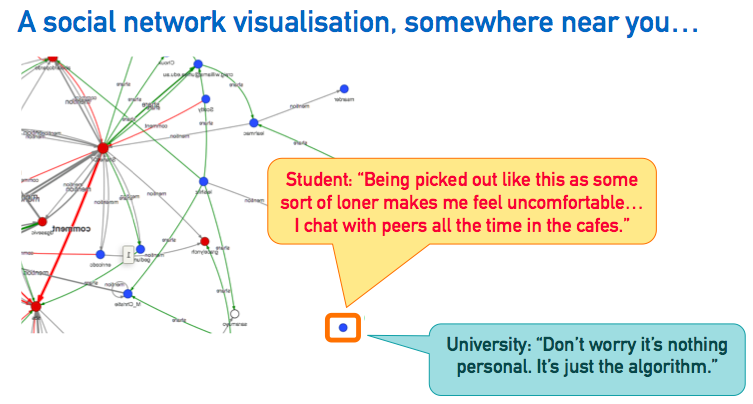
There are many insights to gain from playing these podcasts, but I was particularly tuned to any mention of making the algorithms underpinning analytics intelligible, and to whom. This cropped up a few times when the interviewees discussed to what extent students should be shown analytics, and how to explain their inner workings in a helpful way to them, the teaching staff expected to trust these new tools, and analytics researchers keen to know the inner workings of, for instance, a new analytics product. If handing over an SQL export or full LMS log aren’t considered helpful, what is the right level of detail, and summarised in what ways, for us to be “transparent”? Listening to this, it struck me that in fact this turns out to be a technology-enhanced learning design problem: how to engage non-expert audiences with very complex material to deliver quality ‘learning outcomes’? There’s a few PhDs in that. (I note in passing the Open Learner Models research strand from AIED which is now in dialogue with learning analytics).

It turns out from Niall’s interviews that students aren’t actually very curious, which is in my view a reflection of the data illiteracy in society at large. I certainly intend to make my students very curious about the analytics we run on them, but then, they’re data science students. It would seem that some vendors of predictive models are banking on customers not asking too many questions, because in my interactions with them, they have yet to develop any conception of a service to help a client tune the algorithms to their context.

Back to the JISC interviews. I see the material here, and work on the ethics of learning analytics (e.g. Pardo & Siemens 2014; Prinsloo & Slade 2015) as coming at the problem from one angle, namely ethics/legal compliance/student support/educational institutional processes. Another related but slightly different angle is to approach the problem is to ask what would it mean for a learning analytics system to be accountable to its stakeholders?

This issue is by no means restricted to learning analytics of course. Education is — as ever — slow out of the blocks compared to other sectors that have been transformed by technology. What is encouraging is that as algorithms pervade societal life, they are moving from the sorts of things that only computer scientists and mathematicians would discuss, to becoming the object of far wider academic and indeed media attention [try a web news search on algorithms]. As we (and we might ask, who is we?) delegate machines with increasing powers to make judgements about fuzzy human qualities such as ’employability’, ‘credit worthiness’, or ‘likelihood of committing a crime’, many are now asking how the behaviour of algorithms can be made more transparent and accountable. But in what senses  are they opaque and to whom? What is meant by “accountable”?

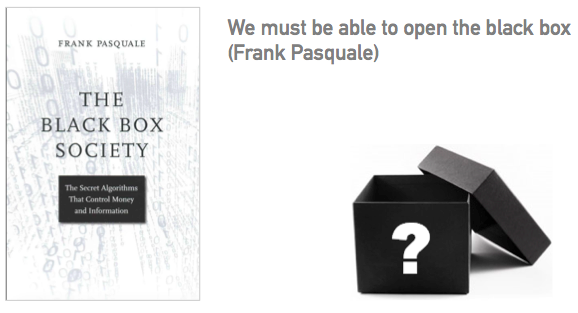
The learning analytics community can learn something from our colleagues in other fields as they wrestle with these questions. I love the provocation piece for the  Governing Algorithms conference, and the sparkling set of videos. Reflect on Tarleton Gillespie’s analysis of Google’s and Apple’s algorithms. Check out Paul Dourish’s recent lecture on the Social Lives of Algorithms. I learnt a lot from Solon Barocas’ tutorial on the ways that machine learning can replicate structural injustice if deployed unethically for recruitment purposes. Watch Frank Pasquale on The Promise (and Threat) of Algorithmic Accountability in the Black Box Society, and be afraid…

pasquale-blackbox

In a series of talks* I am test flying my thoughts as I get to grips with this work. I propose a set of lenses that we can bring to bear on a given learning analytics system to define “accountability” at multiple levels from multiple angles. It turns out that algorithmic accountability may be the wrong focus — or rather, just one piece in the jigsaw puzzle. Intriguingly, even if you can look inside the algorithmic ‘black box’, which is imagined to lie in the system’s code, there may be little of use there. I suggest that a human-centred informatics approach is an appropriate one to embrace when considering “the system” wholistically, where the aggregate quality we are after might be dubbed Analytic System Integrity. I conclude by working through a couple of worked examples from current projects as a form of ‘Analytic System Integrity audit’, to show where one can identify weaknesses.

May 6 update: The following replay is from a talk at the UCL Institute of Education (Knowledge Lab) joint with UCL Interaction Centre. It is v2 of the talk, updating the one I posted earlier from University of South Australia Digital Learning Week.

* My thanks to colleagues for hosting these events: Kirsty Kitto (Queensland University of Technology, Institute for Future Environments), Shane Dawson (University of South Australia, Digital Learning Week), UCL (Manolis Mavrikis), and The Open University (Rebecca Ferguson).

Reflecting on reflective writing analytics

Computational “assessment” of writing elicits strong reactions from many educators. For sceptics, handing over to a machine the task of feeding back or even grading writing crosses a boundary line marking the limits of AI. It also raises the same fears that any disruptive technology brings, around redefining roles and identities in a profession.

Effective writing is not only central to education and the workplace, but a lifelong citizenship competency for engaging in society. Many academic disciplines are concerned with building learners’ skills in critical review, conceptual synthesis, reasoning, and disciplinary/professional reflection. In these subjects, writing is arguably the primary window onto the mind of the learner. Huge effort is invested in literacy from the earliest schooling, extending for many into higher education. Yet educators and employers alike recognise the challenge of cultivating this ability in graduates, with poor written communication skills a common cause of complaint.

Extending beyond scholarly, academic writing, many educators also have a keen interest in disciplined, autobiographical reflective writing as a way for students to review and consolidate their learning, thus providing a means for assessing the deepest kinds of shifts that can occur in learner agency and epistemology. Such approaches are also common in the training and development of professional reflective practitioners.

Writing is, however, labour-intensive to assess, hard to do quickly, demanding for students to learn, and not something that all educators can coach well, or even consider their job to do. It is in addressing these systemic limitations that NLP is attracting significant educational interest, and commercial investment.

Harnessing NLP

As Natural Language Processing moves out of the labs and into mainstream products, and as it becomes a mainstream topic in the Learning Analytics community, we have the opportunity and challenge of harnessing language technologies, and delivering them in effective ways that enhance learning.

NLP capability is of course the key enabling capability, but is just one piece of the puzzle for an effective learning analytics solution: it needs to be tuned by theories of how writing and learning shape each other, the scholarship of teaching writing, appropriate pedagogical practices and user interface design, and evidence from empirical evaluation of the total system, not just algorithmic metrics.

The learning analytics community should be in a position to guide educators and students on the evidence of impact in this new space. What questions should be asked before buying a new product or trialling a new research prototype? What are the options for evaluating such tools? What staff competencies are required to ensure that such tools have the maximum chances of success? Do students need orientation or training? These are the often ignored costs around a potentially disruptive technology.

Promises and pitfalls

Ultimately, educators and students must trust these tools, and the effort of learning a new tool must pay back. Computational “assessment” of writing elicits strong reactions from many educators. For sceptics, handing over to a machine the task of feeding back or even grading writing crosses a boundary line marking the limits of artificial intelligence (AI). It also raises the same fears that any disruptive technology brings, around redefining roles and identities in a profession. The research question is whether or not such scepticism is justified.

Writing Analytics have in common similar potential and pitfalls to other learning analytics applications.

  • The promise is 24/7, personalised feedback at scale, which exceeds what is possible with the limited resources normally available to students. Only a privileged minority of students have access to detailed, timely feedback as they draft texts.
  • What are considered the pitfalls depends on how one frames the design problem. I’d like to propose a critical, whole systems perspective in which the definition of “the system” and “success” is not restricted to IR metrics such as precision and recall, but recognizes the many wider issues that aid or obstruct analytics adoption in educational settings, such as theoretical and pedagogical grounding, usability, user experience, stakeholder design engagement, practitioner development, organizational infrastructure, policy and ethics.

Towards critical, systemic perspectives

In such a critical perspective, writing analytics are problematized. Technical, educational and design thinking need to come together in order to address the range of issues opened up for inquiry:

  • Pedagogically-grounded requirements for language technologies to support a specific genre of writing (even if these are extraordinarily challenging)
  • Design and validation of analytics for different genres of academic writing (e.g. literature review; debate analysis; personal reflection)
  • The relationship between assessment regime and choice of writing analytics (e.g. summative grading for high stakes tests; formative feedback on open ended reflection; individual versus collaborative peer review)
  • Arguments for the potential benefits (or damage) of engaging with writing analytics (e.g. Might rapid feedback disrupt critical reflection processes? Is automated feedback perceived differently by students to human feedback?)
  • Compelling (even fun?) user interfaces for engaging with automated writing feedback (e.g. annotations; visualizations of content and structure)
  • Empirical evaluations of research prototypes and commercial products
  • Principles for embedding software tools into practice (e.g. student and staff orientation; common misconceptions)
  • Organizational adoption case studies
  • Ethical issues specific to writing analytics (e.g. given the range of ideas and emotions that can be expressed)

Reflective writing for wholistic education

Screen Shot 2015-06-26 at 11.30.13 amLast week Georgetown University convened their second Formation by Design (FxD) symposium, a follow-on to the first gathering last year (interim report). FxD is convened by Randy Bass (Vice-Provost, Education), as part of a university-wide initiative framing the future of higher education at their institution as a design problem.

“The core purpose of the Formation by Design Project is to move formational learning (whole person learning) to the center of higher education at a watershed moment. Our goal is to respond to the challenges that the current landscape poses to an integrative and holistic vision of education by creatively redesigning dimensions of the university to ensure that formational learning can both thrive into the future and be extended to an ever-expanding and diversifying population seeking higher education. In order to take advantage of this opportunity we have to reframe formation in the context of the new ecology of learning. In this context, the Project seeks to make an impact in three areas:

Valuing Formation: How do we define formation so that it accounts for the expanding skill-set and wider outcomes of a liberally-educated person in this century? How can we make formation visible as a core educational goal in ways that respond to the emerging learning ecosystem?

Designing for Formation: How can we develop strategies and identify models for integrating formation into the core practices of institutions of higher education? What are some promising learning designs and technologies that foster a broader sense of purpose and human capability appropriate to the new contexts of globalization, complexity, and social connection?

Measuring and Assessing Formation: How do we assess and measure the impact of formational education in reasonably systematic ways, both to demonstrate the value of learning designs and for continuous improvement of them? How might we develop an integrative approach to assessment and measurement tuned to the emerging digital environment that can make learning, and the data from learning processes, visible and usable in new ways?”

However, this is bigger than Georgetown: along the way, Randy has convened Reinvent University for the Whole Person — a stimulating series of video roundtable conversations reimagining education fit for our times.

FxD are particularly interested in reflective writing as a site for learning analytics that fits their wholistic vision of deeper learning, and so invited me to contribute a ‘provocation’ to the symposium, to spark discussion about the roles of analytics in a conception of university education which has a strong liberal arts tradition, and is relatively non-technical compared to other fields and traditions.

Towards reflective writing analytics?

A long term and very fruitful collaboration with Ágnes Sándor in the Parsing and Semantics research group at Xerox Research Centre Europe, is enabling us to trial a range of parsers in educational settings. The collaboration began at the UK Open University with Anna De Liddo in our work on Contested Collective Intelligence (webinar/paper), and now Duygu Bektik’s PhD (latest news). These have focused to date on the relatively mature parser that XRCE has developed for analysing analytical, formal academic writing of the sort found in peer reviewed publications (they have analysed writing including social sciences, genomics and bioinformatics).

Following my move to UTS, we’re continuing to test their parser, developing and evaluating prototype tools (i) to give rapid formative feedback to students on their writing, (ii) as tools to provide educators with clues to the quality of the writing, and (iii) as new kinds of qual/quant analytical tools for researchers. I am greatly enjoying working with the Academic Language & Learning Group in the Institute for Interactive Media & Learning (IML), who collaborate with academics to embed academic literacies across the curriculum. The new reflective writing parser we are developing was grounded in the work by Rosalie Goldsmith.

PhD work by Thomas Ullmann and Andrew Gibson are two other examples of initiatives in reflective writing analytics, with a fifth annual Workshop on Awareness and Reflection in Technology Enhanced Learning coming up, linking others who share a broad interest in reflection for learning.

The twitter dialogue from the FxD symposium with Gardner Campbell has helped me better articulate this, and I look forward to continuing such dialogue.


UPDATE 27 FEB 2016: The above argument above has since been developed into the  motivation for the workshop Critical Perspectives on Writing Analytics. The reflective writing analytics was published initially as:

Buckingham Shum, S., Ágnes Sándor, Rosalie Goldsmith, Xiaolong Wang, Randall Bass and Mindy McWilliams (2016, In Press). Reflecting on Reflective Writing Analytics: Assessment Challenges and Iterative Evaluation of a Prototype Tool. 6th International Learning Analytics & Knowledge Conference (LAK16). Edinburgh, UK. ACM Press. http://dx.doi.org/10.1145/2883851.2883955 Preprint: http://bit.ly/LAK16paper


UPDATE 2017: This paper was subsequently extended and included in a journal special issue of invited papers from LAK16:

Buckingham Shum, S., Á. Sándor, R. Goldsmith, R. Bass and M. McWilliams (2017). Towards Reflective Writing Analytics: Rationale, Methodology and Preliminary Results. Journal of Learning Analytics, 4, (1), 58–84. http://dx.doi.org/10.18608/jla.2017.41.5

In parallel, a further iteration developed a substantially new model of reflective writing, distilled from the literature, and piloted this with pharmacy students:

Gibson, A., Aitken, A., Sándor, Á., Buckingham Shum, S., Tsingos-Lucas, C. and Knight, S. (2017). Reflective Writing Analytics for Actionable Feedback. Proceedings of LAK17: 7th International Conference on Learning Analytics & Knowledge, March 13-17, 2017, Vancouver, BC, Canada. (ACM Press). DOI: http://dx.doi.org/10.1145/3027385.3027436. [Preprint] [Replay the video] Awarded LAK17 Best Full Research paper.

UPDATE 2018: Our pharmacy colleague Cherie Lucas also won an award for this work, published as:

Lucas, C., Gibson, A. and Buckingham Shum, S. (In Press). Utilization of a novel online reflective learning tool for immediate formative feedback to assist pharmacy students’ reflective writing skills. American Journal of Pharmaceutical Education. https://doi.org/10.5688/ajpe6800

OpenU Valedictory Lecture

SBS_Valedictory_LectureOn 31st July I fly to join the University of Technology Sydney, directing the new Connected Intelligence Centre. More on that later!

Meantime, here’s the replay of yesterday’s reflections on nearly 19 years in KMi and the OU (my talk starts 10mins in). My deepest thanks to all my colleagues for the memorable send-off! Slides embedded below, or download as PDF. Read on however, for news of the KMi team who take this work forward in the OU, and for a few ‘Director’s Cut’ additions — the  clips that I was dying to show, but just couldn’t squeeze in!

The Contested Collective Intelligence research programme continues!

As well as pursuing this research in Sydney, in KMi my longstanding research fellow Anna De Liddo takes the team’s work forward, with Michelle Bachler continuing to provide the programming that has underpinned our work over the years, joined recently by Brian Plüss (research associate) on the EPSRC Election Debate Visualization Project, and Thomas Ullmann (research assistant/developer) on the EU Catalyst Project. PhD students Duygu Simsek (discourse analytics for academic writing) and Simon Knight (epistiemic commitments and collaborative online search) complete the new look team, of whom I’m very proud 🙂


Anna De Liddo

Michelle Bachler   Brian Plüss   Thomas Ullmann   Duygu Simsek   Simon Knight

Extra clips:

Tools to build the web of ideas and arguments

The EU Catalyst Project represents the current state of the art in our web apps for Contested Collective Intelligence. Check out the demo movies on our YouTube channel to see how LiteMap enables you to highlight clips of interest in source materials, and place them into an emerging summary map of the debate; DebateHub moves us beyond posting an idea to be voted on, to more careful reflection on its pros and cons; and the CI Dashboard enables you to configure views onto deliberation spaces — all based around the ‘DNA’ of reflective dialogue which I introduced: variations of Questions, Ideas, Pros and Cons. Two examples…


The Evidence Hub is a slightly different platform, architected to pool a community’s collective knowledge (as a web of ideas and arguments) about what works (and fails) in tackling pressing issues. Designed to connect researchers, practitioners, policymakers and enterprise, a Hub also geographically maps the people, projects and organisations behind those ideas. It comes with built-in analytics, alerts and report generation:

Knowledge, skills, and dispositions

A clip from the Reinventing University video roundtable on New Metrics, in which Ruth Deakin Crick introduces her work on assessing learning dispositions. You can learn more about dispositional analytics in this replayable workshop, and our conference presentation.

Video from a case study of designing authentic inquiry with explicit assessment of the above learning dispositions, in Bushfield School, Wolverton. I was delighted to be joined on Tuesday by the two Headteachers I’ve worked with closely as Chair of Governors,  Andrea Curtis and Steve Springett-McHugh, who embody the kind of vision, courage and compassion needed by school leaders today.

Reinvent University for the Whole Person

“As universities adapt for the 21st century, what could be done now, like never before, to fully educate future workers, citizens and fulfilled human beings?”

This is the very challenging question which Randy Bass is exploring in a 6-part series of video roundtables (each with a 10min summary) to Reinvent the University for the Whole Person.

Wholistic learning analytics is a frontier research challenge in my view, so I was delighted to be invited to join one of the roundtables last night, considering the next step in digital/physical learning environments to help build the qualities that graduates need. We had a fascinating conversation, building on the previous ones. Thanks to Randy, my fellow Reinventors, and Reinventors.net who do a great job facilitating such conversations and producing these 10min summaries, in case you want a preview of the full 90mins:

Next up: New Metrics…

In more detail, this goal of the series is to reframe the conversation about the future of higher education…

The Roundtables

Each roundtable takes on a different aspect of the challenge. The roundtables build on each other with an eye of driving towards our desired outcomes.

Topics and sub-questions to be explored include:

  1. The Whole Opportunity: What is the bigger picture opportunity ahead for educating the whole person as universities get transformed in the 21st century?
  2. Next Skill Sets: What will be required for young and old to thrive in the coming digital, global world of many challenges? What is the role of an integrative education in transferring those skills?
  3. Next Physical & Virtual Environments: What are the design principles for future learning environments that strike the optimal balance between the virtual and local?
  4. New Metrics: How will we measure the impact of education, capturing the full range of outcomes we value? What are the “analytics” of an integrative education?
  5. Principles Driving Policy: What are the opportunities for shaping public policy for integrative education in a world that also needs more access, lower costs and more preparation for the workplace? How do we ensure that the focus is not elitist?
  6. Strategies for Organizational Change: What are the key mechanisms for change inside universities that will accelerate reinvention?

The Goals

The entire series is designed to move our collective thinking towards some specific goals, including:

  1. Reframe the discussion to include a compelling vision of educating the whole person in the 21st century, and why this is critical to shaping a better future.
  2. Highlight key strategies for moving the current system forward – from new metrics and organizational change strategies, to ending false debates between online and offline education.
  3. Empower change-makers in the field – from administrators and faculty, to the broader community of parents and alumni – with new ideas to accelerate the changes we want to see in the future.

What if we used learning analytics to power NICs?

I’ve just posted some reflections on time spent last week with Tony Bryk (President, Carnegie Foundation for the Advancement of Teaching), hosted by Ruth Deakin Crick at University of Bristol. What follows after a brief introduction to the concept of Networked Improvement Communities (NICs), are my thoughts on the intersection of NICs with Learning Analytics.

Screen Shot 2014-05-29 at 22.38.40

with Gulzhan Azimbayeva • Harvey Goldstein • Ruth Deakin Crick • Tony Bryk


Moving: children taking charge of their learning

For me, there’s nothing quite so moving in the world of learning than witnessing teachers give young people the responsibility and safe freedom to show what they are capable of, and then seeing those children talking about how that felt, and showing what they did.

Tragically our national curricula often crush this possibility out of school life, but when it happens, it’s startling. And the network of people sharing the evidence and stories is building. The movie below is an example from my local primary school, with whom I work:

Bushfield Y5 Fashion Project 2013 from Bushfield School on Vimeo.

Full details:

Small, T., Shafi, A. and Huang, S. (2014) Learning Power and Authentic Inquiry in the English Primary Curriculum: A Case Study, Report No. 12, ViTaL Development & Research Programme, University of Bristol. [pdf]

This report documents progress in a two-year action-research programme at Bushfield School, Milton Keynes, with two main purposes: firstly, to build on the School’s success in developing children’s capacity to learn; secondly, to track and measure the impact of its interventions for this purpose. The school combined the Effective Lifelong Learning Inventory (ELLI) with the Authentic Inquiry learning methodology from University of Bristol. Qualitative and quantitative data are combined to examine the impact of the pilots from the perspective of staff and pupils, comparing learning power against a range of demographic and attainment datasets, in the distinctive context of a primary school already experienced in the Building Learning Power approach.

One community who are active right now is the Deeper Learning MOOC (DLmooc), which is doing a fabulous job of catalysing conversations about the future shape of learning, with a good dose of student voice. Check out the YouTube/Vialogue replays of their live Hangouts.

I just added a couple of stories to the set they’re compiling, from the above work with Bushfield School, which has benefited from working first with Guy Claxton on ‘building learning power’, and most recently with Ruth Deakin Crick on assessing learning dispositions and authentic inquiry, both strands of work originating from University of Bristol Grad School of Education (disclaimer — I’m a visiting fellow there: now you know why!):

I have no idea how “massive” this MOOC is, but they’re doing a good job in this course of bringing together reflective practitioners and students.